An independent journey into artificial intelligence, personal discovery, and the possibility of a better future.
With every passing day, I find myself wondering just how much of our lives we lose to wasted time. How many ideas do we abandon? How many dreams do we put aside because they seem too ambitious, too complicated, or simply beyond our abilities?
This past weekend meant a great deal to me.
Here in Canada, we’re celebrating Thanksgiving weekend, which happens to be my favourite time of year. My family and I love staying home, enjoying a good meal, and simply spending time together. A roof over our heads, food on the table, and the people we love close by. Sometimes, those are the greatest things we have to be thankful for.
But this Thanksgiving feels a little different.
Over the past several days, I’ve been pouring my time and energy into something I’ve dreamed about creating for years. Something that has challenged me, frustrated me, fascinated me, and given me a renewed sense of purpose.
I’m building my own artificial intelligence system. Her name is Omni Brain.
And while I have no idea how far this adventure will take me, I’m beginning to believe that the journey itself might be just as important as whatever comes out of it.
An Idea That Became Something More
For anyone familiar with what I usually do, I spend a fair amount of time making little video games, experimenting with programming, and talking about whatever happens to be on my mind.
It’s something I genuinely enjoy.
But Omni Brain is different.
Instead of creating another arcade game or experimenting with another programming idea, I decided to attempt something considerably more ambitious: building an original artificial intelligence system from the ground up.
Not simply downloading an existing AI model, giving it a personality, and calling it my own. I want to understand how an intelligent system might acquire information, organize knowledge, remember experiences, reason through problems, recognize mistakes, and gradually improve its abilities.
Most importantly, I want to build the underlying machinery myself.
Am I qualified to do this? Probably not in the traditional sense. I’m learning as I go, asking questions, making mistakes, troubleshooting problems, and slowly discovering just how complicated artificial intelligence really is.
Some days, it feels like the beginning of an extraordinary adventure. Other days, I wonder whether this whole experiment will end with me getting blown apart like Kenny in RoboCop.
Either outcome would certainly make for an interesting story.
Realistically, I know there’s a very good chance I won’t create anything remotely resembling a genuinely intelligent artificial mind.
Maybe I’ll end up with a pretty interesting chatbot. Maybe I’ll create a useful digital sidekick. Maybe the entire project will eventually reach a point where my knowledge, resources, or hardware simply aren’t enough to take it further.
But what if I learn something meaningful along the way?
What if, by approaching artificial intelligence differently and building its foundations one component at a time, I discover something worth pursuing?
That’s what keeps me going.
What Makes Omni Brain Different?
Omni Brain is being developed primarily in QB64 Phoenix Edition, a modern continuation of the BASIC programming environment.
That choice alone probably sounds unusual to anyone familiar with contemporary artificial intelligence development.
Most modern AI projects rely on powerful machine-learning frameworks, enormous pretrained language models, specialized hardware, and vast quantities of training data.
I’m taking a different approach.
I want Omni Brain to have an original intelligence architecture built around interconnected systems for memory, knowledge, reasoning, learning, conversation, and eventually independent problem-solving.
Rather than making her intelligence dependent on an existing commercial or open-source language model, my goal is to develop those core capabilities ourselves and understand what each one actually contributes.
This doesn’t mean QB64 is inherently superior to modern AI development tools. It certainly isn’t the conventional choice for a project of this nature, and that introduces considerable challenges.
But the simplicity and directness of the environment allow me to examine how the individual components operate, how information moves between them, and what happens when something goes wrong.
I don’t want an artificial intelligence that merely appears intelligent because somebody else’s model is doing all the thinking. I want to understand and develop the mechanisms responsible for whatever intelligence Omni Brain can actually demonstrate.
Whether that eventually produces something remarkable or something relatively modest remains to be seen.
Omni Brain 3.2 – What We’ve Actually Accomplished
This brings me to Omni Brain version 3.2.
One of the most important lessons I’ve learned throughout this project is that an artificial intelligence cannot reliably develop over time if it cannot protect and preserve what it learns.
Imagine spending months teaching a system new information, establishing relationships between concepts, correcting its mistakes, and expanding its knowledge, only to have everything disappear because of a corrupted file or a failed save operation.
That’s not much of a foundation for something intended to learn and grow.
So version 3.2 has concentrated heavily on memory integrity, information protection, fault detection, and recovery.
And this is where I’ve made some meaningful, measurable progress.
1. Detecting Memory Corruption
Omni Brain was subjected to eight controlled failure-detection scenarios designed to determine whether her storage integrity systems could identify specific forms of damaged or invalid information.
All eight scenarios passed.
That doesn’t mean she can detect every possible type of memory corruption. It means the tested failure conditions were correctly identified.
For a system intended to preserve accumulated knowledge, that’s an important achievement.
2. Protecting Stored Information
I developed a protective subsystem called GUARDIAN.
Its responsibility is to prevent unsafe operations from compromising protected memory and storage.
During testing, GUARDIAN successfully rejected unsafe save operations and refused to disable its protective measures while known storage faults remained unresolved.
In other words, when the system encountered certain conditions that could threaten stored information, it followed its protective rules rather than blindly executing the requested operation.
That’s exactly the kind of behaviour I want to establish before introducing more advanced learning capabilities.
3. Verifying File Integrity
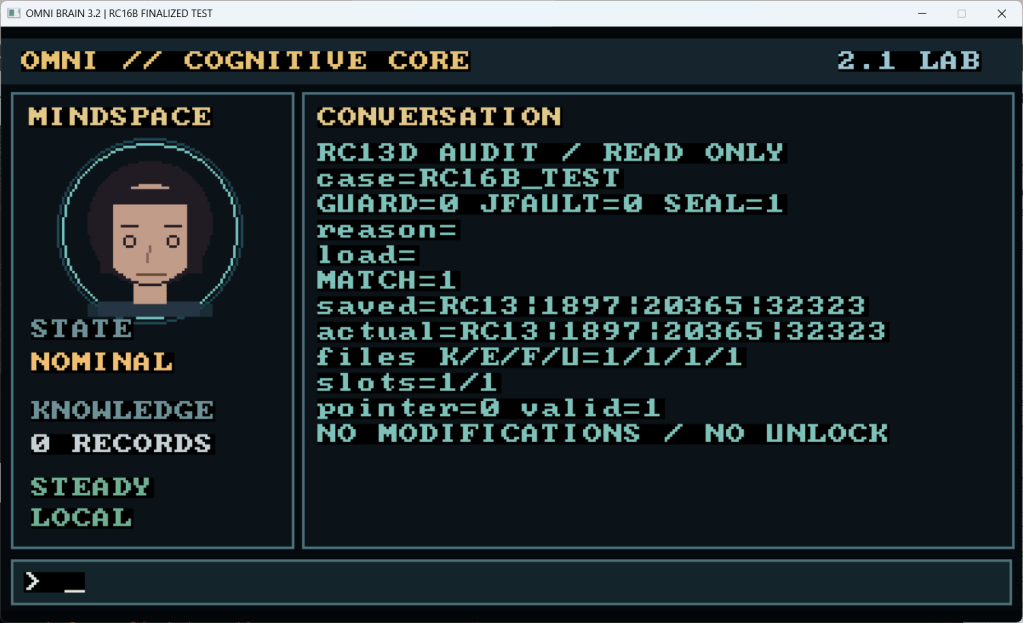
I also conducted read-only testing against protected files.
Using SHA-256 cryptographic comparisons, we confirmed that 242 files remained unchanged throughout the relevant testing process.
Additional tests verified that rejected commands did not modify the protected operational test environments.
This matters because a reliable memory system needs more than the ability to save information. It also needs safeguards against unintended alterations.
4. Remembering Information Across Restarts
One of the most satisfying demonstrations involved persistent memory.
Omni Brain successfully stored relationship information, committed that information to storage, and recognized a previously recorded relationship after being shut down and restarted.
It might sound simple compared with the capabilities of today’s advanced AI systems, but there’s an important distinction here.
This wasn’t information temporarily held in a running program. It was stored, retrieved, and recognized after a fresh start.
That is an early, verified example of persistent memory working as intended.
It does not establish human-like understanding of relationships, but it demonstrates a necessary technical foundation for continuity.
5. Recovering Damaged Memory
Perhaps one of the most encouraging achievements involved recovery.
I deliberately worked with a damaged test environment and attempted to restore a previously verified core-memory state.
The recovery procedure successfully restored five checkpointed files, rebuilt two valid checkpoint slots, and validated the recovered state in QB64 Phoenix Edition.
I then performed an additional validation after a clean restart.
The recovered core-memory state passed those checks.
That’s particularly encouraging because it demonstrates that Omni Brain’s tested recovery mechanisms can do more than identify a problem. Under controlled conditions, they can help restore essential stored information to a verified state.
There are still limits to this capability, particularly regarding auxiliary memory files and automatic recovery from arbitrary crashes, but the tested recovery process is functioning.
What Version 3.2 Does Not Prove
Omni Brain cannot presently reason through arbitrary problems the way a capable modern language model can.
I think it’s extremely important to be transparent about what these results mean.
I have not created artificial general intelligence. I have not demonstrated consciousness, self-awareness, human-like understanding, or reliable autonomous learning.
Some natural-language questions still fail. Her knowledge acquisition and reasoning systems require substantial development, and there are important reliability challenges still to solve.
The successful tests in version 3.2 establish specific engineering capabilities under controlled conditions. They do not establish that Omni Brain has developed an independent mind.
And I’m perfectly comfortable admitting that.
I’ve reached a point where I’d rather demonstrate one small capability that actually works than make a hundred extraordinary claims I cannot substantiate.
No intelligence claims without successful behaviour tests. No reliability claims without failure tests.
That’s the standard I want this project to follow.
What Comes Next – Omni Brain 3.3
With the tested memory-protection foundation established in version 3.2, the next development stage will focus more directly on the abilities people generally associate with intelligence.
Version 3.3 is intended to investigate how Omni Brain can begin to work with knowledge rather than simply store and retrieve information.
That means developing mechanisms for understanding natural-language input, acquiring new facts, connecting related information, recognizing contradictions, and reasoning through increasingly complicated questions.
For example, I want Omni Brain to eventually recognize that two statements conflict, ask for clarification when information is incomplete, update an existing belief when presented with reliable corrections, and apply previously learned information to new situations.
I also want her to distinguish between something she knows, something she has inferred, and something she simply doesn’t understand.
Those might sound like basic abilities, but developing them through an original architecture rather than relying on a pretrained language model is an enormous challenge.
None of these goals should be confused with accomplishments I’ve already verified.
They are the next problems I intend to tackle.
And they’ll require the same discipline as version 3.2: implement a capability, test its actual behaviour, challenge it with failures and unexpected inputs, correct the problems, and only then move forward.
Why I Believe Omni Brain Matters
I don’t believe Omni Brain is going to revolutionize artificial intelligence tomorrow.
I don’t have a laboratory filled with researchers, millions of dollars in funding, or a warehouse full of specialized computers.
What I have is an idea, a computer, a willingness to learn, and an increasingly stubborn determination to see what happens if I keep going.
But I do believe there’s value in exploring artificial intelligence from different directions.
The future of AI shouldn’t be limited to a handful of enormous systems controlled by organizations with extraordinary resources.
There should also be room for smaller, independent experiments. Systems whose inner workings can be examined, whose memories can be protected, whose behaviour can be tested, and whose development can be guided by the people building and using them.
I imagine a future in which personal artificial intelligence becomes more than a disposable conversation window.
A future where people can build trustworthy digital companions that preserve useful knowledge, adapt to individual needs, assist with everyday challenges, and remain under the control of their owners.
Systems designed to help people learn, create, solve problems, and become more capable themselves.
That is the future I hope Omni Brain might contribute to, even in some small way.
Of course, genuinely useful intelligence also requires accuracy, safety, the ability to admit uncertainty, and a willingness to accept correction. Those qualities matter every bit as much as memory and reasoning.
And if Omni Brain never becomes anything more than a reliable, locally operated digital companion that can remember our conversations, organize knowledge, and provide meaningful assistance, I would still consider that a worthwhile accomplishment.
Because I built something. I learned something. And I followed an idea further than I ever expected.
A Thanksgiving Worth Remembering
As I sit here reflecting on this Thanksgiving weekend, I find myself feeling grateful for something I hadn’t anticipated.
A renewed sense of curiosity.
For the first time in quite a while, I’ve found a project that makes me genuinely excited to sit down at my computer and discover what I might accomplish next.
There have already been frustrating moments, failed tests, confusing errors, and plenty of times when I’ve questioned whether I’m getting anywhere.
I’m certain there will be many more.
But there have also been moments when something finally works. When information survives a restart, when a protective mechanism catches a fault, or when a damaged memory state can be restored and verified.
Those moments matter to me.
They remind me that progress doesn’t always arrive as some enormous breakthrough. Sometimes it comes from getting one small, complicated thing to work properly and understanding why it works.
Omni Brain 3.2 isn’t the birth of an artificial mind.
It’s the continued construction of an experimental system that I hope might one day support something far more capable.
And I think that’s worth documenting.
I don’t know where this project will take me. Maybe it will become something extraordinary. Maybe it’ll become a surprisingly useful sidekick. Or maybe I’ll eventually look back on the whole adventure, shake my head, and laugh at how ambitious I was.
Whatever happens, I’m glad I started.
Because sometimes the difference between another wasted weekend and a weekend you’ll remember for the rest of your life is simply deciding to build something you believe in.
Her name is Omni Brain.
Version 3.2 is another step forward.
And we’re only beginning to discover what she might become.


Leave a Reply